
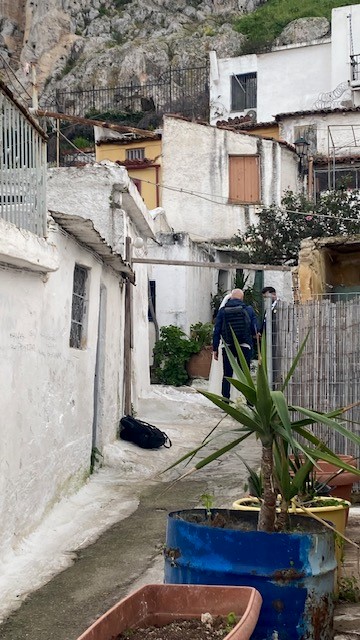
Anafiotika is one of my favourite places to stroll in Athens: a little traditional village hidden under the Acropolis, on the northeastern side.
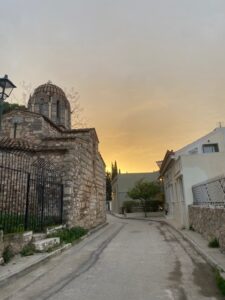
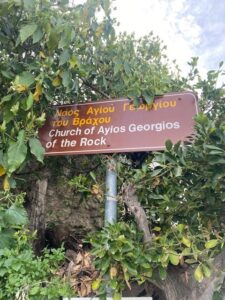
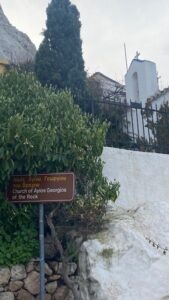
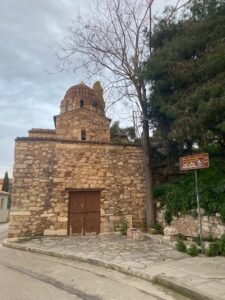
I prefer to start my promenade from the Holy Church of Saint George of the Rock (at the end of Stratanos Street), although if you are in Plaka, you can reach this quiet, fairy-tale-like place just by starting to climb up the stairs and narrow street heading towards the Acropolis’s direction. Ascend the staircases and immerse yourself in the gradually increasing silence, away from the cacophony of the bustling city.
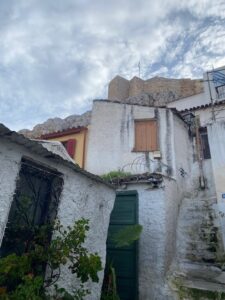
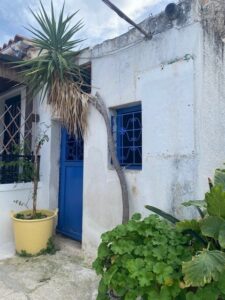
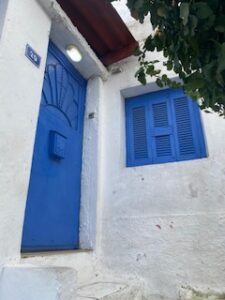
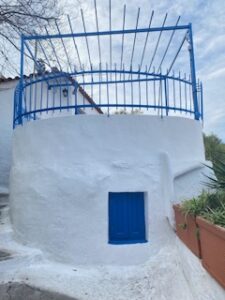
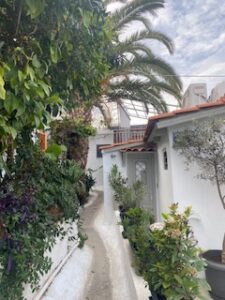
Some colourful graffiti might remind you that you are in the 21st century, but as you reach this area, you will feel like a time traveller on a Cycladic island. Tiny houses with white walls, blooming plants all around, and brightly coloured doors and windows surround the narrow, winding streets.
Cycladic heritage
Indeed, Anafiotika has strong connections with the small Cycladic island Anafi, which lies just a few kilometres away from Santorini.
In the early 19th century, when King Otto wanted to refurbish his palace, inhabitants from Anafi and other islands came to the capital to work. Since they were not offered a place to live while working on the construction of the palace, they started to build homes for themselves on the slope of the Acropolis, in the same architectural style they used on their island.
According to the legend, there was a quite unusual law stating that if someone could erect a structure between sunset and sunrise, the property would be theirs. The resourceful builders did just that – built their houses during the night. A unique enclave – Little Anafi – was born, thanks to the swiftly constructed Cycladic homes.
A little bit of history
In 1834, a decree was issued designating the region as an archaeological zone, making it illegal to reconstruct there. However, this legislation was not always respected by the arriving workers.
In 1922, after the catastrophic destruction of Smyrna in Asia Minor, a lot of Greek refugees settled here too. The residents of Plaka and the inhabitants of Anafiotika did not get on well at the beginning of the 20th century. The Anafiotes retaliated by prohibiting any Plaka residents from moving throughout their neighbourhood after the locals refused to allow the “villagers” to visit Philomousou Square.
Another interesting fact is that Anafiotika was called “Black Stone” during the Turkish occupation because their slaves from Africa were living in this area.
In the 1950s, part of this area was demolished for archaeological reasons; as a result, only about 45 houses remain with approximately 70 inhabitants. It is an isolated area, where you can completely forget that you are in a busy capital city.
A truly special atmosphere
One must respect this place, as most of the residents are elderly people who deserve their privacy. Anafiotika is so calm that if there weren’t freshly washed clothes hanging in the gardens, you would think that it is deserted.
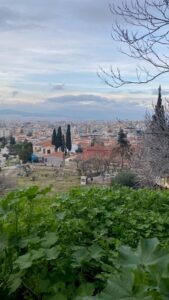
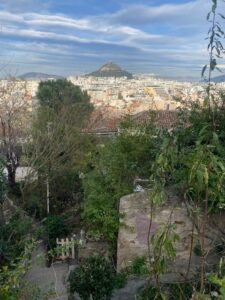
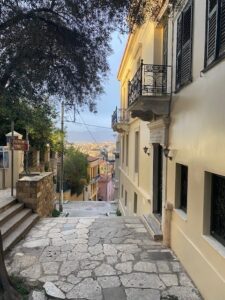
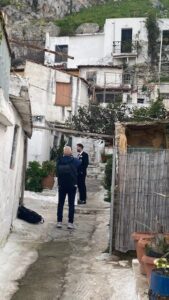
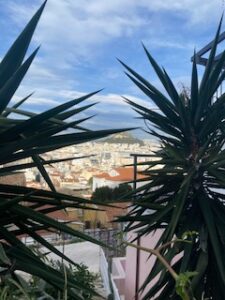
Whenever I walk here, I always feel like I am entering someone’s garden. The cobbled alleys are extremely narrow; the low built houses are so close to each other that it is difficult to see whether I am ending up in a private area or just climbing the stairs that belong to the street. It is well worth it to be brave and follow one’s instinct. The view from here is spectacular, especially from the terrace next to the house nr. 34. (There are no street names in Anafiotika, only house numbers.)
The Holy Church of Saint Simeon
There is another beautiful small church in Anafiotika, the Holy Church of Saint Simeon of the Anapheans, built right by the Acropolis’ wall in the neoclassical style. In front of the church there is a lovely terrace, offering a stunning panorama of Athens.
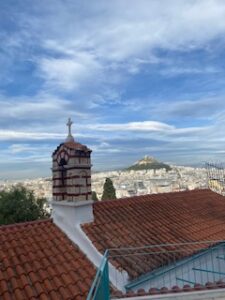
The hectic life of Athens vanishes; cats are lazily hiding under the trees, birds are chirping constantly, and the flowers in the colourful pots are blooming. If you look up, the top of Lykavittos Hill – with the immense city lying at its feet – will greet you in the distance.
What a beautiful insight into this part of Greece. A truly delightful read. Thank you