The Athens-Epidaurus Festival
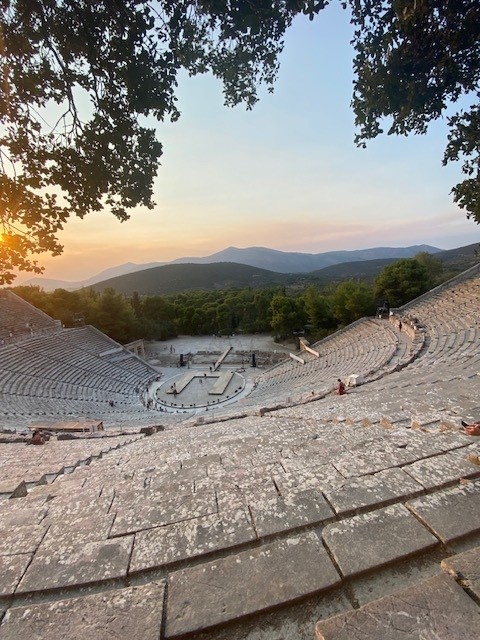
It was one of the greatest experiences of my life. The Frogs. Not the croaking little green ones, but Aristophanes’ comedy at the ancient stone theatre of Epidaurus.
The Athens-Epidaurus Festival is the country’s most renowned artistic event, with a long and prestigious history. In 2025, it celebrated its 70th anniversary. The festival runs from June to October and incorporates a significant range of genres: music, dance, and theatrical productions are all included in the programme, with both classical plays and contemporary performances.
The event takes place at several venues. The two most significant of which are the Herodes Atticus Theatre in Athens, located on the slopes of the Acropolis—where, thanks to a long wait in line at dawn, I had the fortune of listening to Pavarotti from the stands—and the ancient stone theatre in Epidaurus.
The history of the Ancient Theatre in Epidaurus
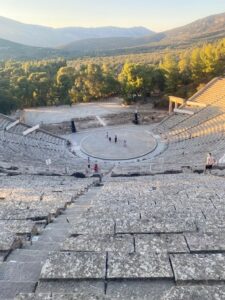
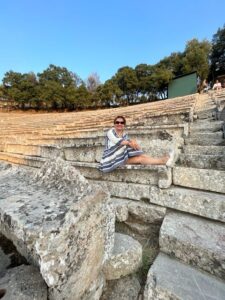
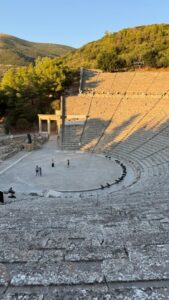
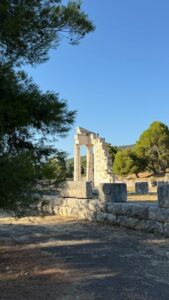
I find it simply amazing that here, in Greece, you can enjoy a play in a theatre that has been standing for millennia. The one in Epidaurus is nearly 2350 years old. We can watch the performance from the same marble benches where the ancient Greeks sat. Okay, maybe it was mostly the Romans who sat there, since the theatre was built in the 4th century BC but was expanded in the 2nd century AD. At this time, it was expanded by 21 rows to accommodate even more spectators, to a total of 14,000.
In the Middle Ages, the ancient theatre of Epidaurus was forgotten, buried by the earth and overgrown with vegetation in many places. The building was laid dormant until 1881, when an enthusiastic Greek archaeologist, Panos Kavadiás, began to excavate it.
Today, it is a UNESCO World Heritage site. It became famous not only for its location and size but also for its excellent acoustics. The usual trick of the tour guides is to drop a coin in the middle of the “orchestra” (the flat, half-circular centre of the stage) because the sound of it can be heard even in the highest rows of the theatron (the steep, curved seating area built into the hillside).
I love the Italian tourists the most, because they always sing often popular songs I recognise from my travels there. Of course, the guards don’t always take this well, but if you sit back and watch, you can see some special scenes unfolding.
Asclepius’ healing sanctuary
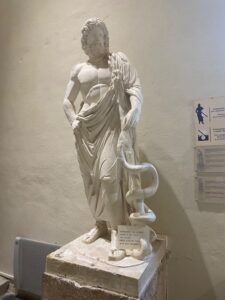
What piqued my interest even more than the Italian performances was the fact that the theatre was not built as an independent theatre but as an integral part of the world-renowned Asclepius’ healing sanctuary in ancient times.
The ancient Greeks believed that the health of the body and soul were closely interconnected. Therefore, it was not only prayer, rest, baths, dreams, interpretations, herbs, and diets that aided in healing, but also cultural experiences, such as theatre. The performed dramas could bring a catharsis (and hence spiritual purification) to the viewers, which may well lead to their healing. The performances confronted the audience with their own inner fears and pains and often helped them process these.
The theatrical performance was also a communal experience, and the awareness of belonging to a community, knowing that others are seeking healing in a similar way, provided significant emotional support to those wishing to heal.
Hence, the theatre was one of the tools of Asclepius’s healing. Patients were treated in the rooms next to the temple, and then they watched theatrical performances. This experience thus complemented the healing treatments. The famous Greek physician, Hippocrates, and his disciples also wrote about the healing power of poetry, music, and theatre.
I’m not sure about the healing power, but I am certain about the inspiring power, because I was overwhelmed with enthusiasm at the thought of seeing a play in this theatre. Since I hadn’t mastered the Greek language yet, I looked for a comedy because situational humour is easier to understand and enjoy than a tragedy. Nowadays, this isn’t a problem because theatres have electronic screens that subtitle the plays in English, but back in 2000, this wasn’t the case.
Practical Information
Epidaurus is located about an hour and a half’s drive from Athens, so I had plenty of time to read the play to my partner (and myself) in the car so we would arrive at the performance well-prepared. I still recommend this or at least reading the synopsis today, subtitles or not. The play is always more enjoyable when one knows the story well.
On performance days, you can expect a traffic jam at the surrounding villages close to the theatre. The police always control the traffic, and parking is provided in the large field next to the Asclepius sanctuary. On the day we went, the traffic was flowing, but slowly – you can imagine the number of cars if you think of a theatre with 14000 seats.
It’s hard to be late in Greece because everyone else is always late too, but in this case it’s still worth getting there on time.
A truly special experience
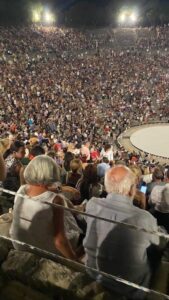
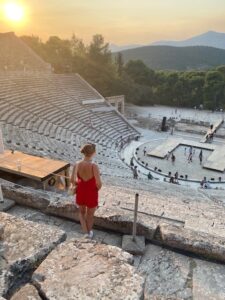
Even before the performance, I was in complete ecstasy. I was particularly moved as we walked towards the theatre in the light of the setting sun. So many people, such a huge theatre! I felt like a tiny drop in this vast whole. But this little drop is watching an ancient comedy in an ancient Greek theatre today!
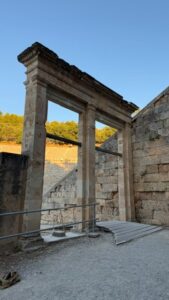
Then, as we walked up the steep marble steps, searching for our seats, the building itself left us in awe. Huge. On both sides, the elegant columns still stand, and behind the stage, one can see quite far. What a job it must have been to build this theatre!
The mountains of Arcadia grew darker in the distance, the lights came on, and the buzzing audience of the fully packed theatre fell silent.
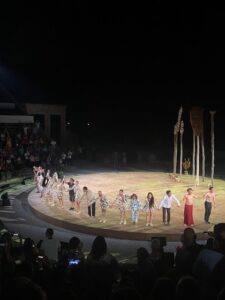
The performance was fantastic. To this day, I remember details from it. The sets and costumes were very simple, but the acting! Brilliant. We laughed until we cried, even though we didn’t fully understand every word of the play.
Since we fell in love with the village of Palaia (Old) Epidaurus, which is located near the theatre, we are happy to return. My daughter is also studying drama at high school, so now there are more of us in the family who are fans of Greek drama. Not to mention that tickets for the performances start at 15 euros, so I have plenty of reasons to keep coming back to this theatre, not just as a tourist wandering through the Asclepius sanctuary but as a theatre lover too.
Last year we watched Euripides’ Bacchae, which I found a bit too slow and rather long. Aristophanes’ comedy Birds, on the other hand, was a huge success with the whole family.
I firmly believe that if someone vacations in Greece, it is definitely worth taking a look at the Athens-Epidaurus Festival website. Although tickets for concerts of famous performers sell out quickly, with a little luck you can get great (and cheap) seats in Epidaurus or in the Herodes Atticus Theatre in Athens. Even when we were not so fond of the performance itself, the atmosphere of the theatre, the outdoor event as a whole and the beautiful view definitely offer a once-in-a-lifetime experience.
https://aefestival.gr/?lang=en
https://www.visitgreece.gr/en/mainland/peloponnese/epidaurus